
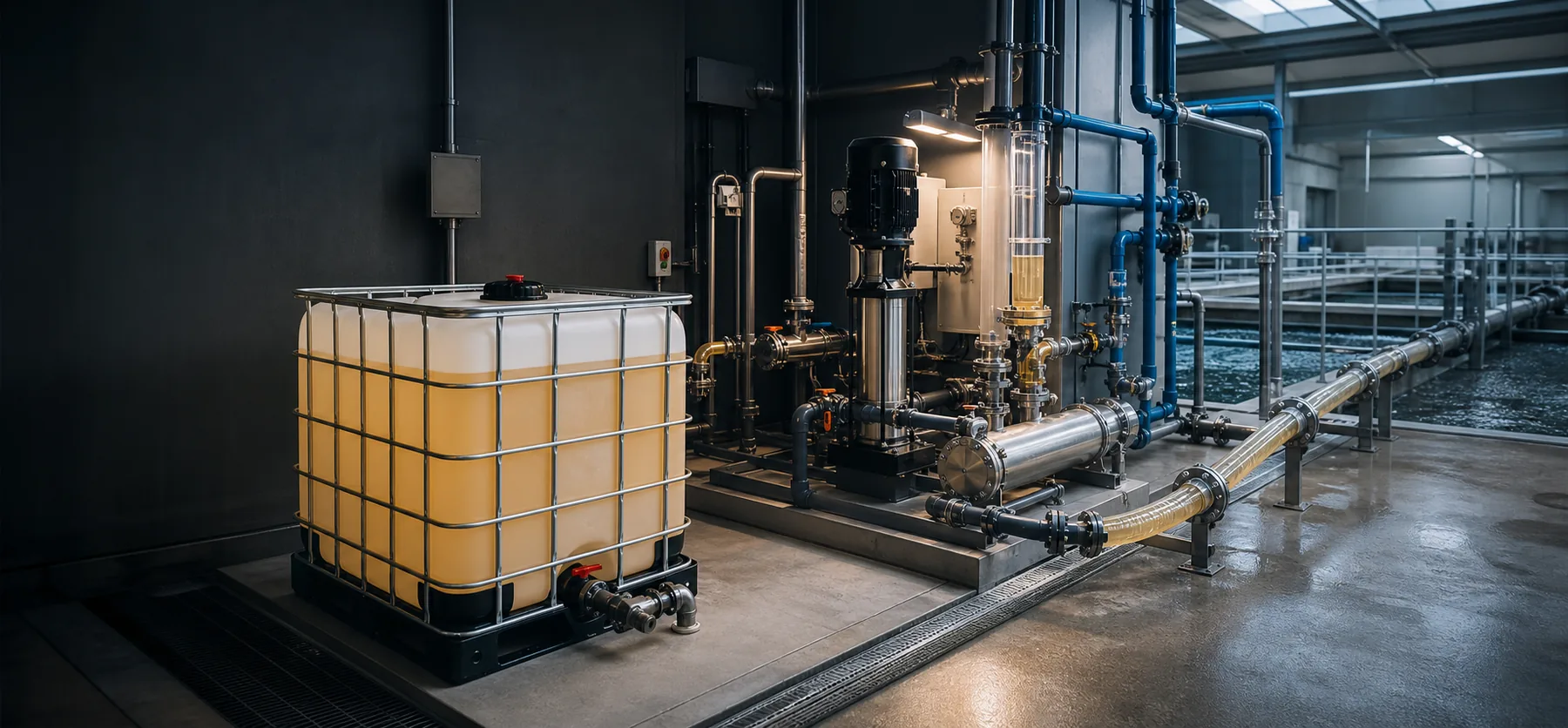
Recognize an inverse emulsion
A polyacrylamide emulsion used for industrial separation is commonly an inverse water-in-oil system. Polymer-rich aqueous particles are dispersed within a continuous carrier phase and stabilized for transport. The commercial liquid is therefore not the same as a ready aqueous polymer solution.
When the product meets sufficient water and the inversion system supplies suitable contact, the emulsion structure changes and polymer chains become available in water. This activation step is part of product performance, not merely a convenient dilution.
Separate physical form from ionic chemistry
Emulsion describes how the commercial polymer is supplied. Cationic, anionic, nonionic and low-charge profiles describe chemical interaction with the feed. Molecular structure and charge density still need to match solids, dissolved ions, upstream chemistry and the separator.
Do not assume every emulsion is a dewatering polymer or that every liquid product is cationic. Request a clear product identity and compare candidates through a controlled application test.
Understand the operating advantage
Liquid emulsion can support automated handling and a shorter route from neat product to usable solution than dry powder when the inversion skid is correctly designed. That can help compact plants, mobile systems or operations requiring rapid product change.
The advantage disappears if the neat pump drifts, water-emulsion contact is poor or the solution is dosed before adequate activation. Equipment condition belongs in the evaluation.
Account for the inactive fraction
The delivered emulsion contains polymer plus carrier and formulation components. Quotation price per kilogram of commercial product therefore cannot be compared directly with a high-active powder price.
Use the supplier's declared basis and method, calculate cost per unit of active polymer, and then compare the active dose needed for the same measured separation.
Match product to separator evidence
Sludge dewatering may emphasize centrate or filtrate capture, cake solids and throughput. Clarification may emphasize interface rate, overflow quality and compaction. DAF also requires stable float formation and skimming.
Define the endpoint before screening charge profiles. An attractive beaker floc is supporting evidence, not a universal approval.
Build a defensible sample request
Include feed source, solids, pH, conductivity, upstream chemicals, equipment, current polymer, active-dose basis and desired output. Add inversion water, system type, storage temperature, package and destination.
This record lets the supplier choose a meaningful sample set and keeps the final product code connected to the test result.
Read product data without inventing equivalence
A useful data sheet identifies the commercial product, ionic character, declared active or solids basis, physical handling range and preparation guidance. Viscosity or charge indicators only become comparable when their method, concentration, water and temperature are known. Two emulsions with similar descriptive labels may use different methods or molecular architectures.
Ask which values are routine lot controls and which describe a typical profile. Use those fields to preserve identity, then let the controlled application trial decide whether the grade fits the process.
Set boundaries for substitution
When replacing powder with emulsion, changing supplier or moving between emulsion grades, begin with the current active dose and measured endpoint. Do not assume equal commercial kilograms or identical activation. Qualify the candidate across normal and difficult feed while retaining the incumbent as a control.
State which changes in feed, water, equipment or formulation require a new screen. One successful trial defines an operating window, not a universal result.