
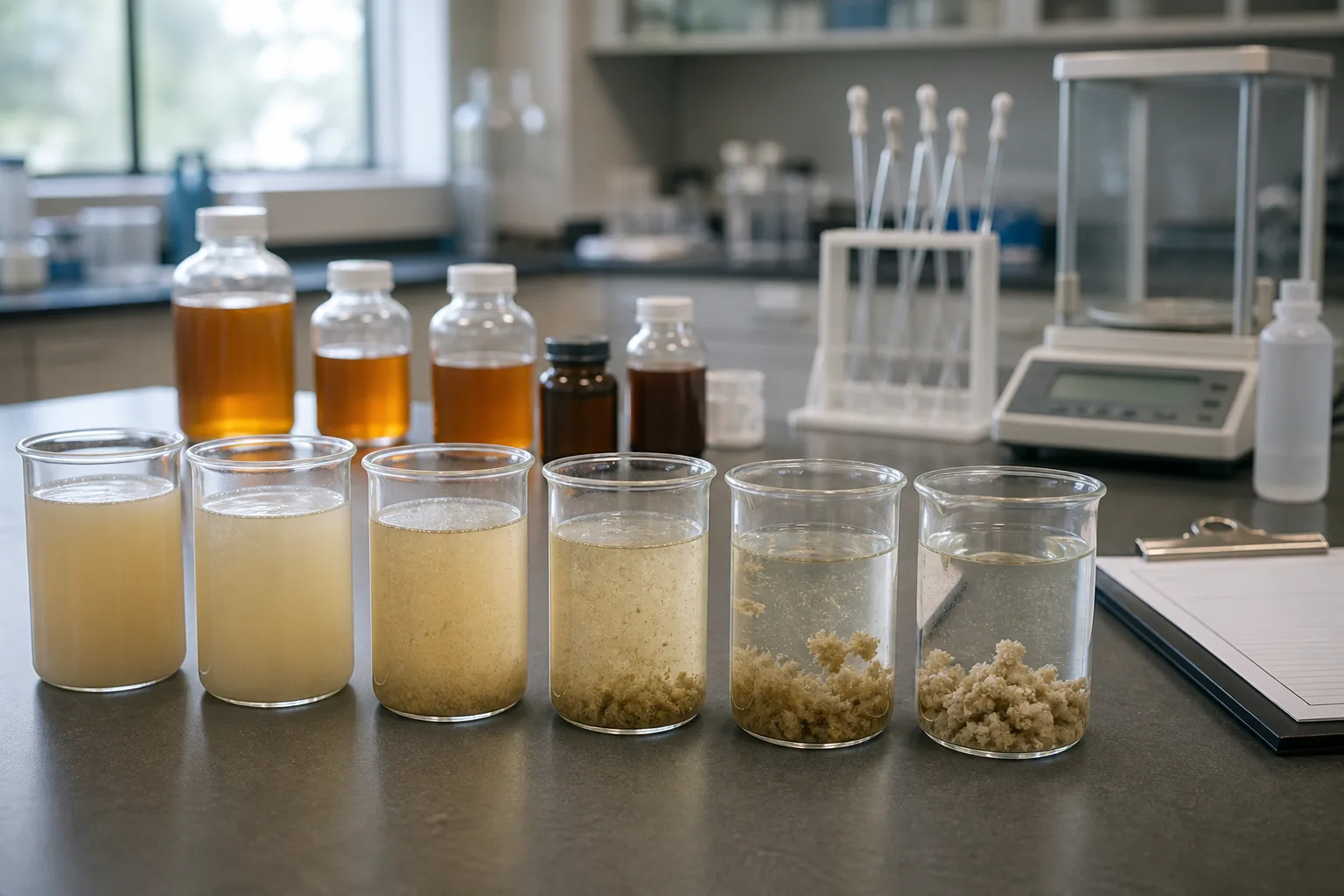
Use low charge as a deliberate comparison
A nonionic or low-charge profile can test whether molecular reach and bridging dominate the separation response. It is useful beside ionic candidates when particle charge is uncertain or upstream chemistry changes the exposed surface.
Low charge is not a guarantee of tolerance. Dissolved ions, solids concentration, molecular structure and inversion quality still determine whether polymer chains reach and connect the particles.
Build a complete dose curve
Run a blank, the current plant polymer and adjacent charge profiles at equal active dose. Keep neat-emulsion conditioning, water quality, inversion ratio, aging and mixing sequence fixed.
Measure clarified water or filtrate, rate, compacted volume and response after repeatable shear. Retain the rejected underdose and overdose points because they define the useful control window.
Resolve close candidates operationally
When separation results are similar, compare emulsion stability, pumpability, inversion equipment fit, delivered active-polymer cost and storage conditions. A technically acceptable product can still be unsuitable for the plant temperature or chemical-room layout.
Request the product profile and supply option with process data rather than relying on a generic nonionic description.