
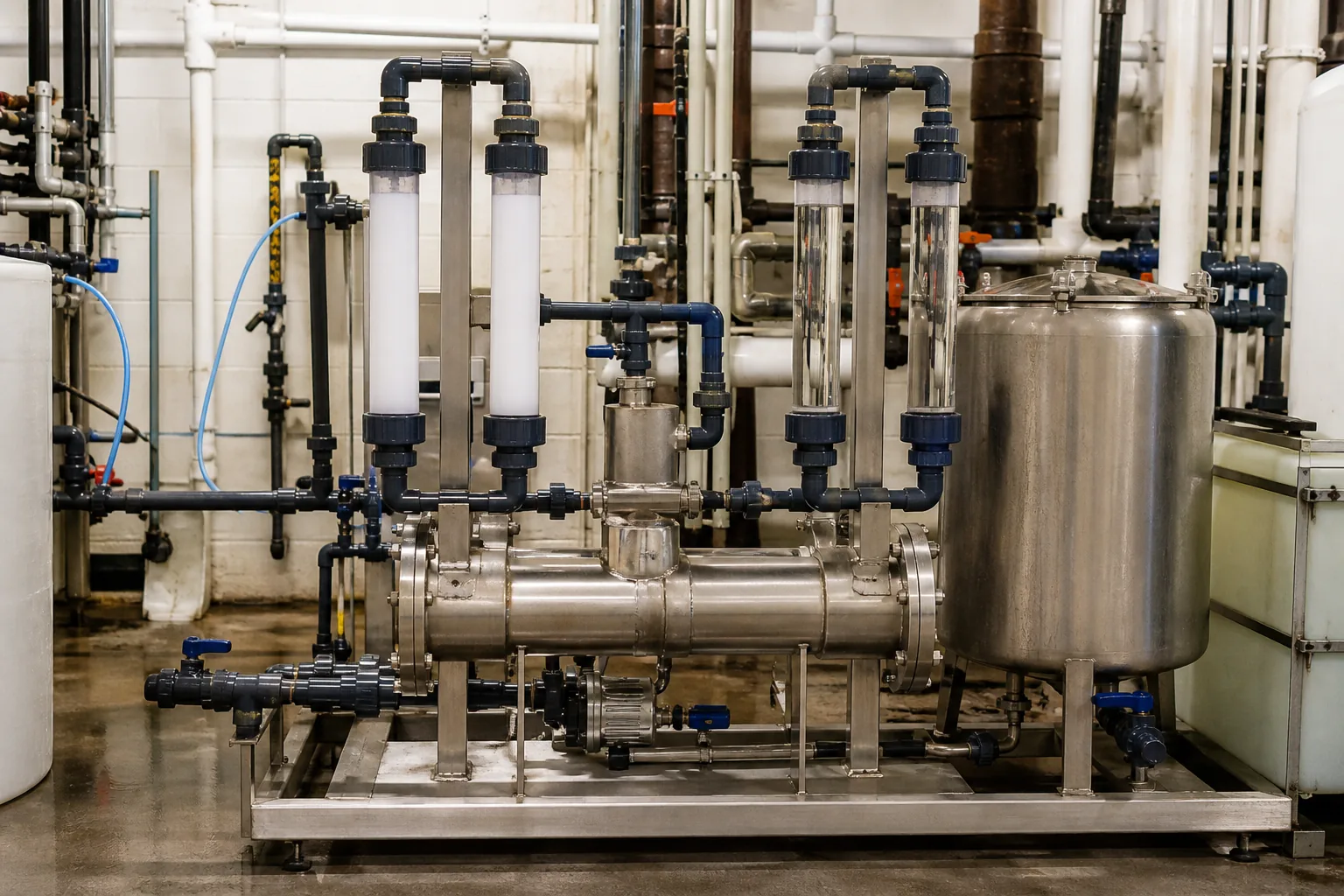
Treat inversion as a process stage
Inverse emulsion must be introduced into a sufficient water stream so its polymer-rich particles disperse and release polymer into the continuous phase. Pouring water into a stagnant mass of neat emulsion or relying on a quiet storage tank does not provide the same contact.
Follow the grade-specific supplier procedure. Record neat flow, water flow, pressure, temperature and the equipment path used for every trial.
Control the first contact
The point where emulsion meets water needs enough local energy to separate droplets before they agglomerate. That does not mean applying damaging shear throughout the mature solution. Distinguish intense initial dispersion from later gentle transfer.
Inspect injectors, check valves and strainers for deposits. A partially blocked water or product path changes the real ratio even when controller setpoints remain unchanged.
Review inversion-water quality
Hardness, salinity, alkalinity and temperature can change activation speed and solution behavior. Use the plant's actual make-down water during qualification. If water quality varies seasonally, test the difficult condition rather than relying on one laboratory batch.
Do not publish a universal recipe. Supplier formulation and water chemistry determine the acceptable concentration and aging window.
Verify flow instead of trusting setpoints
Calibrate the neat emulsion pump by timed volume or mass and verify water flow independently. Reconcile tote consumption with run hours. Air ingress, slipping pump elements and viscous cold product can create large delivery errors.
Document the final solution concentration on a commercial-product and active-polymer basis so plant and laboratory doses remain comparable.
Allow activation before final judgment
Some systems provide inline activation followed by short residence; others use a small maturation vessel. Observe solution uniformity and process response at defined ages. Do not compare a fresh candidate with an aged incumbent solution.
Avoid unnecessary recirculation through high-shear pumps after activation. Mechanical damage can reduce the useful molecular reach.
Recognize incomplete inversion
Deposits, gel-like fragments, erratic pressure, low apparent viscosity or unexpectedly high neat dose can indicate poor activation, but none is conclusive alone. Confirm pump delivery and compare a correctly prepared laboratory control.
Correct the equipment or water-contact fault before rejecting the polymer chemistry.
Transfer the approved method
Record product code, lot, storage condition, water source, flows, contact device, residence and final dilution. Add shutdown and flushing instructions that prevent neat emulsion from sitting in unsuitable water-contact zones.
A reproducible method makes later lot and supplier comparisons technically meaningful.
Design shutdown and restart
Water and neat emulsion should not remain in an uncontrolled contact zone where localized activation can form deposits. Map lines containing neat product, partially inverted material and mature solution, then follow equipment and supplier instructions for stopping, draining or flushing each segment.
After an extended stop, verify valve position, water flow, injector condition and pump prime. Record the first stable solution time so startup material is not used to judge chemistry.
Connect the bench method to the skid
A bench preparation provides a chemistry control, but hand stirring and clean water do not reproduce every plant skid. Translate the qualified sequence into measured plant variables: water and emulsion flow, contact device, pressure, residence, dilution and injection delay.
If results disagree, compare prepared-solution and raw-feed samples. This separates activation, feed variation and downstream shear without changing several variables together.