
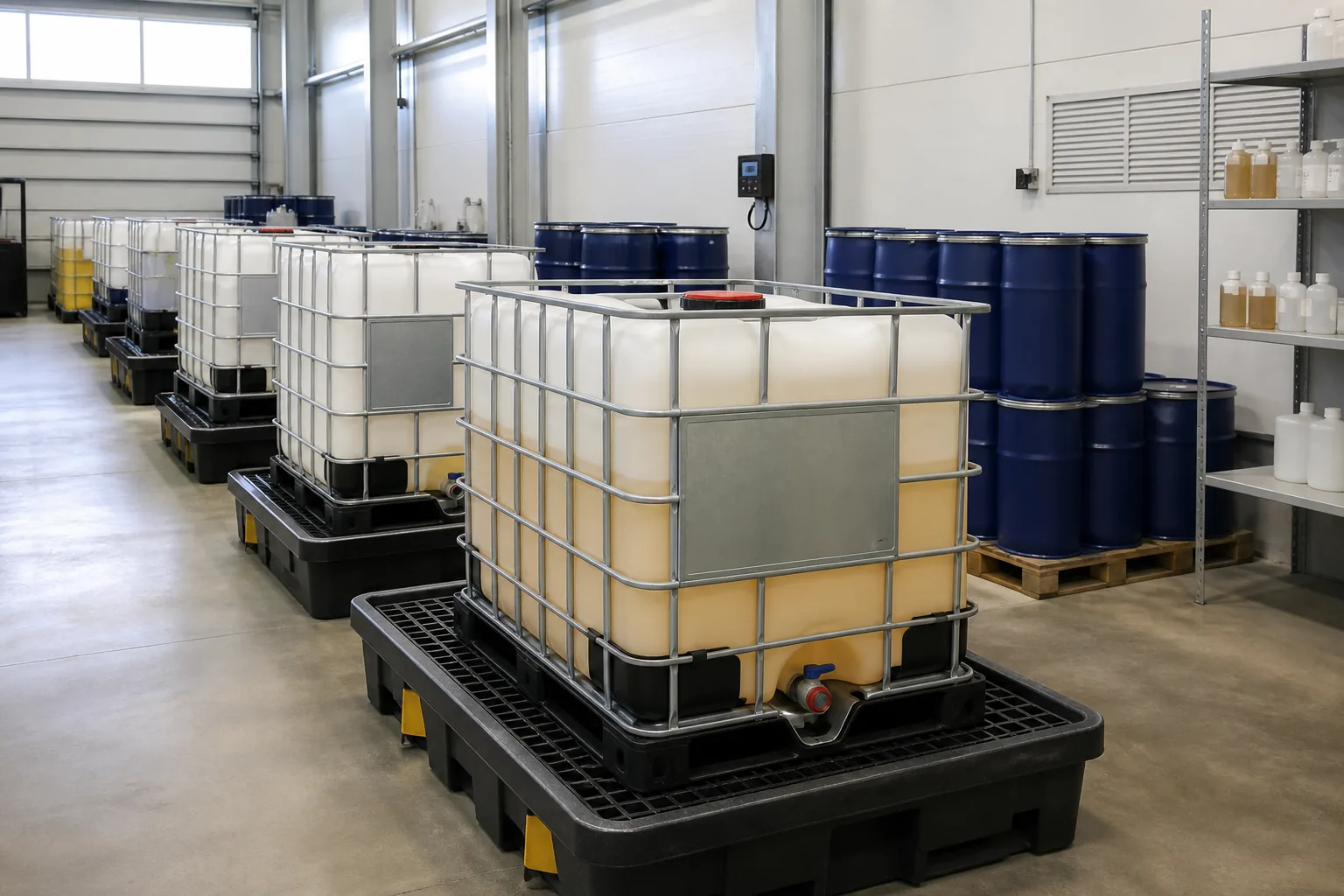
Set the purchase boundary
The right package is the one the site can receive, store and empty consistently within the product guidance. A lower freight rate per tonne does not make an IBC preferable where access, consumption or transfer arrangements favor smaller units.
Identify the proposed commercial grade and the operating condition that must be demonstrated before an order is released.
Start with receiving and consumption
Check unloading access, lifting equipment, chemical-room dimensions, containment and normal consumption. Compare package turnover with the supplier-stated storage conditions. The handling guide covers the product path after receipt.
Ask for actual offered net mass, external dimensions and connection information; do not infer them from a generic package name or assume every tote contains the same quantity.
Review the transfer arrangement
Match the package outlet or pickup system to the approved neat-product pump and hose. Consider safe isolation, drip containment and the ability to verify depletion. Identify whether repeated small-package changes increase the chance of wrong-grade connection.
Request supplier and equipment confirmation for connections and wetted components rather than improvising a transfer setup after delivery.
Include the end of the package
Measure or reasonably estimate the residual heel and identify return, disposal and cleaning responsibilities under the applicable site procedures. Include packaging charges and return freight if they are part of the offer.
Compare cost using recoverable delivered product, not a theoretical completely empty container. Keep unverified heel assumptions separate until the first order provides a measured value.
Check the difficult case
An IBC can reduce change frequency but become unsuitable if the plant takes too long to consume it or cannot use its outlet safely. Drums can improve handling flexibility while adding connection work; the decision should follow the actual site constraints.
Keep unresolved limitations in the qualification record instead of presenting a proposed benefit as an established operating result.
Record the acceptance evidence
| Check | Evidence | Decision |
|---|---|---|
| Receipt | Access, dimensions and mass | Package can be handled safely |
| Transfer | Approved connection and pump | Neat delivery reproducible |
| Completion | Heel and package responsibility | Total offered cost explicit |
Retain the sample code, lot, preparation method and measured feed with the purchasing decision. Compare subsequent deliveries with that record, using the same test conditions wherever practicable.
Request a scoped offer
Provide expected weekly usage, unloading and storage limits, transfer connection, destination and preferred return arrangement. Ask for separate drum and IBC offers only where both formats are operationally feasible.
Send the evidence through the sample and quotation form. Review packaging and lot controls with Gongyi Xinqi Polymer Co., Ltd., and confirm grade availability and order terms before committing.