
Set the purchase boundary
A lower price per delivered kilogram is not automatically a lower polymer cost. Buyers need to know what fraction the supplier calls active and whether another quoted percentage measures the same thing. Total solids and active polymer must not be treated as interchangeable without a defined method.
Identify the proposed commercial grade and the operating condition that must be demonstrated before an order is released.
Ask what the percentage represents
Request the test basis, units and whether the quoted value is typical, guaranteed or a release range. Clarify how formulation components affect the reported result. The active-dose calculation guide provides the mass balance once a defensible active fraction has been agreed.
Do not infer polymer content from color, neat viscosity or a broad product-family description. Keep unverified values as open questions in the offer comparison.
Normalize the delivered offer
Use the same currency, destination and delivered mass basis. Dividing delivered cost per product kilogram by the agreed active fraction gives a screening cost per active kilogram. If consumption is volumetric, use the product-specific density at a stated condition rather than assuming one litre weighs one kilogram.
Separate this normalized chemical cost from the active dose required by the actual separator; both are needed for a treatment-cost decision.
Resolve a close result with a trial
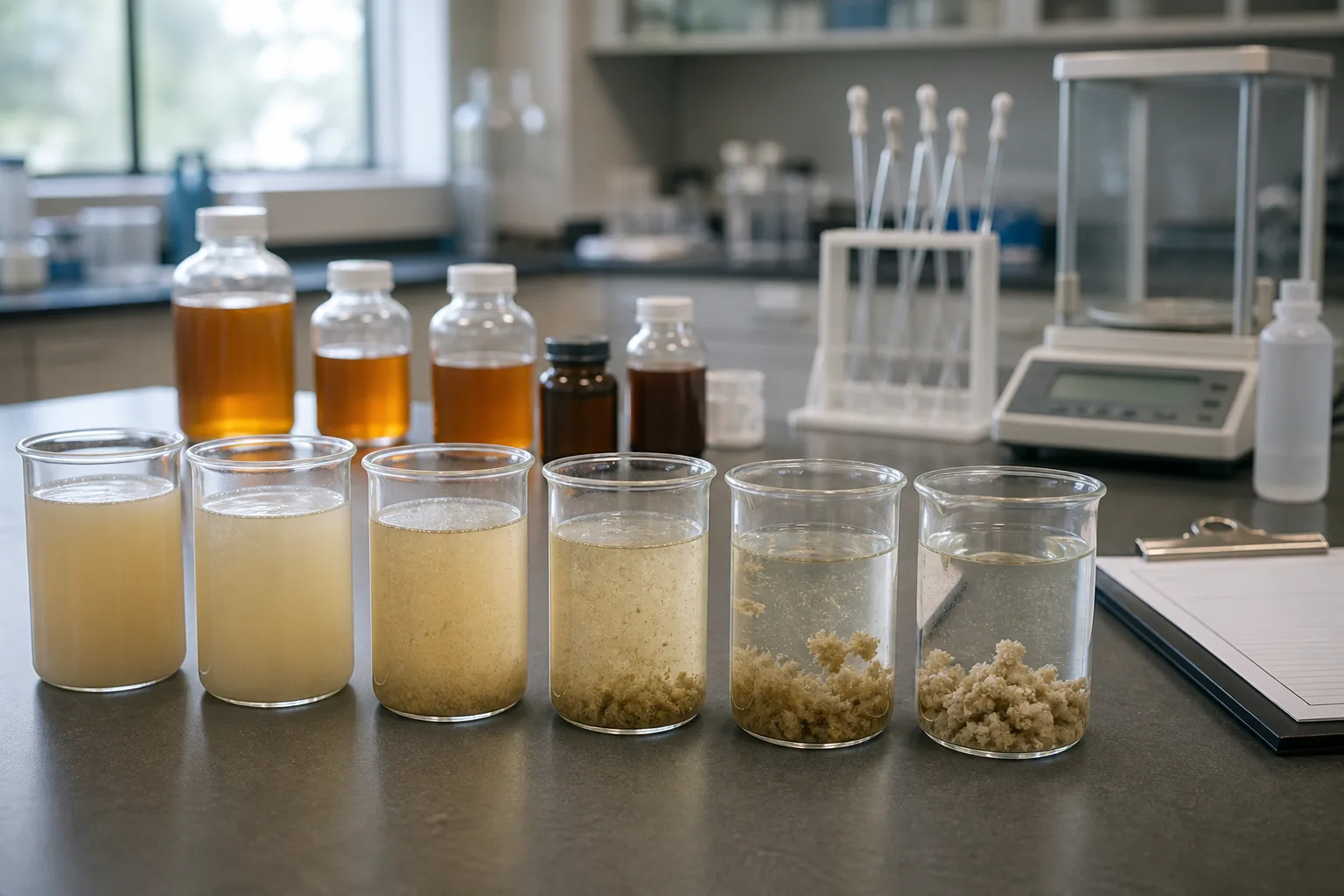
Compare candidate and incumbent at equal active dose under the same preparation and feed conditions. Measure the output quality and operating range, then calculate the amount of commercial liquid required. A higher-active product can still be a poor purchase if inversion or performance is unsuitable.
Record measurement uncertainty. A difference smaller than pump-calibration or feed-solids uncertainty should not be presented as a proven saving.
Check the difficult case
Illustrative arithmetic only: an offer of 2.00 currency units per kilogram at an agreed 0.40 active fraction screens at 5.00 per active kilogram. That calculation is not a current quotation and does not predict the dose or total treatment cost.
Keep unresolved limitations in the qualification record instead of presenting a proposed benefit as an established operating result.
Record the acceptance evidence
| Check | Evidence | Decision |
|---|---|---|
| Basis | Method and declared fraction | Percentages are comparable |
| Units | Mass, density and currency | No litre-to-kilogram shortcut |
| Performance | Equal-endpoint dose curve | Price follows useful treatment |
Retain the sample code, lot, preparation method and measured feed with the purchasing decision. Compare subsequent deliveries with that record, using the same test conditions wherever practicable.
Request a scoped offer
Provide both quoted bases, product data sheets, delivery location, calibrated consumption and the acceptance endpoint. Ask the supplier to identify any missing measurement before issuing a comparative commercial proposal.
Send the evidence through the sample and quotation form. Review packaging and lot controls with Gongyi Xinqi Polymer Co., Ltd., and confirm grade availability and order terms before committing.