
Set the purchase boundary
A mineral-thickener purchase requires a balanced result: useful settling with acceptable overflow and manageable underflow. Choosing an emulsion only for the fastest interface movement can miss constraints that determine whether the plant can use it reliably.
Identify the proposed commercial grade and the operating condition that must be demonstrated before an order is released.
Preserve the slurry condition
Use actual process solids and representative recycle water. Record particle-size context, solids loading, pH, conductivity and upstream reagents. The mineral process-water guide explains why clean-water reconstructions can be misleading.
Keep changes in ore or fines fraction visible. A candidate tested on a favorable slurry should not receive unrestricted approval for untested feed conditions.
Compare more than initial rate
Prepare candidates consistently, bracket active dose and measure overflow clarity alongside interface movement and compaction. Include a repeatable shear comparison where it informs the feedwell question. Record solution preparation and slurry dilution separately so either can be reproduced later.
Do not treat a larger floc as sufficient evidence of useful thickener performance. Retain the dose points that create poor clarity or difficult compaction.
Transfer the decision to the thickener
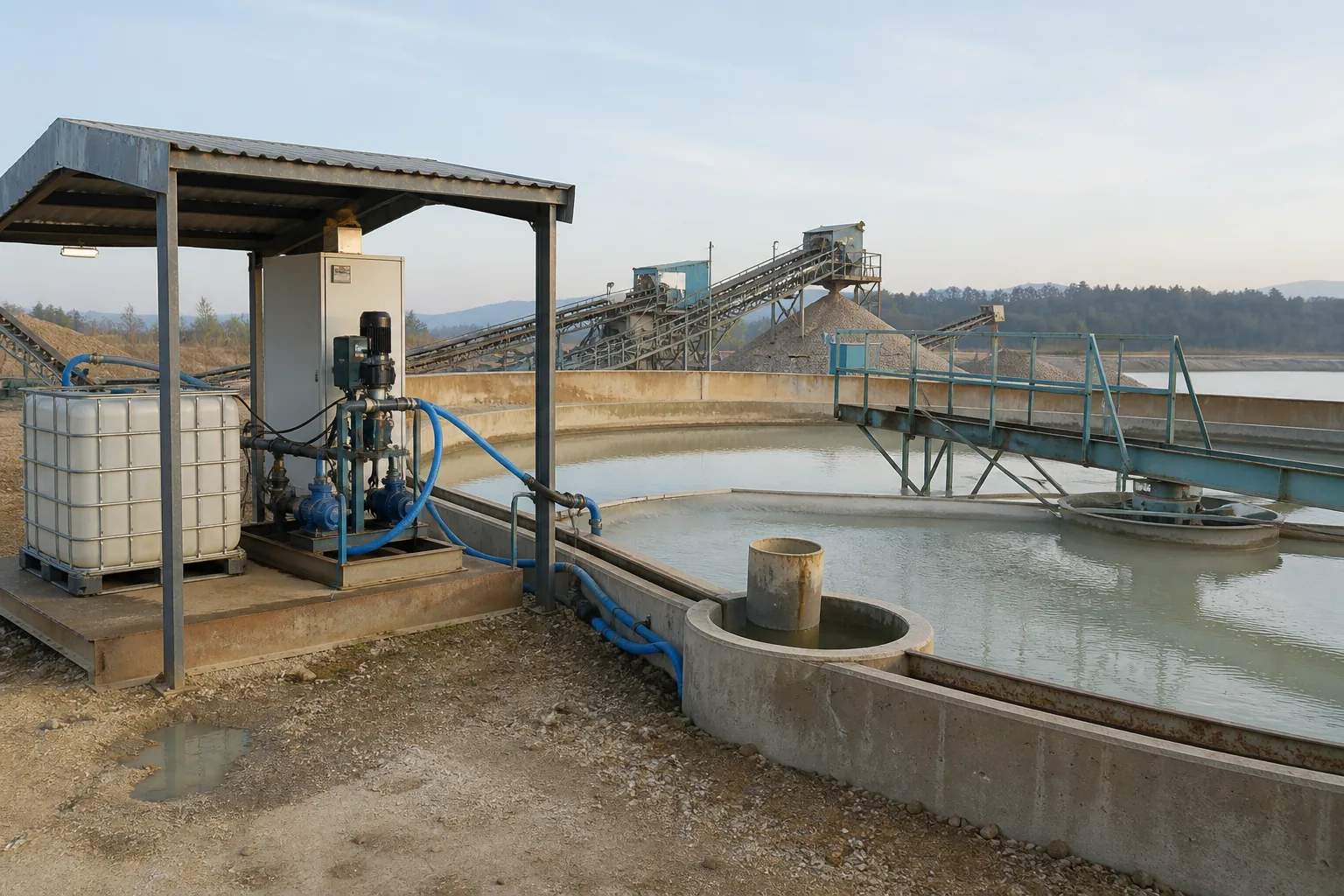
Review the actual injection location, feedwell contact and loading. During the plant trial, allow for system inventory and record bed and underflow behavior as well as overflow. Link calibrated liquid addition to the chosen loading basis.
If downstream pumping or disposal limits determine acceptance, include those observations explicitly rather than promising a benefit from a short laboratory settling test.
Check the difficult case
A candidate may accelerate settling yet form an underflow that the existing withdrawal arrangement cannot handle. It has not passed the complete duty even if its initial settling curve is better; evaluate the operating balance before awarding supply.
Keep unresolved limitations in the qualification record instead of presenting a proposed benefit as an established operating result.
Record the acceptance evidence
| Check | Evidence | Decision |
|---|---|---|
| Feed | Real slurry and recycle water | Representative comparison |
| Bench | Rate, clarity and compaction | No single-metric approval |
| Plant | Feedwell and underflow record | Complete duty accepted |
Retain the sample code, lot, preparation method and measured feed with the purchasing decision. Compare subsequent deliveries with that record, using the same test conditions wherever practicable.
Request a scoped offer
Send mineral and slurry details, operating water, current grade, thickener loading, injection arrangement and output constraints. Ask for a small anionic candidate set tied to both overflow and underflow targets.
Send the evidence through the sample and quotation form. Review packaging and lot controls with Gongyi Xinqi Polymer Co., Ltd., and confirm grade availability and order terms before committing.