
Set the purchase boundary
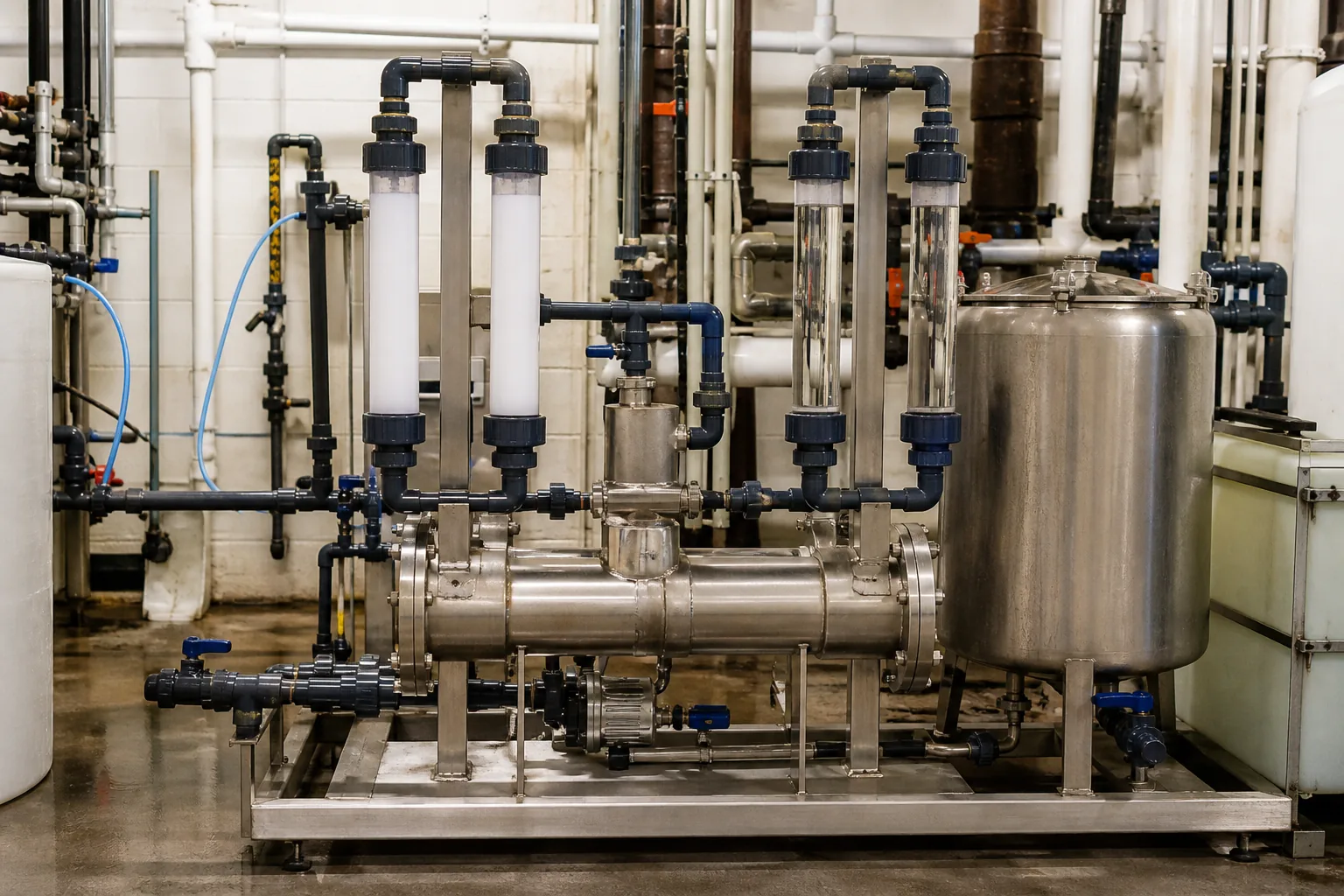
A technically promising emulsion is not a suitable purchase until the installed skid can prepare it over the required operating range. Treat the skid as a defined boundary, with measured flows and available residence rather than only a nominal capacity on a nameplate.
Identify the proposed commercial grade and the operating condition that must be demonstrated before an order is released.
Map the real equipment limit
Record the neat pump, water meter, contact device, solution path and aging volume. Include minimum and peak demand, injection pressure and hours of operation. The commissioning guide provides a sequence for verifying these limits before evaluating new chemistry.
Ask the equipment supplier to identify the stable range and wetted-material compatibility for the specific product, especially when the current service differs from the proposed grade.
Compare the grade requirement
Obtain product-specific activation instructions and compare them with actual water quality and available contact time. If the candidate requires a different dilution arrangement, state the modification explicitly. Do not assume one successful hand-prepared solution proves compatibility with every inline device.
Inspect representative prepared solution and connect its condition to a repeatable application result. Preserve the preparation record beside the product code.
Test demand changes
Run at low, normal and high required flow while maintaining the intended water-to-product relationship. Verify pump calibration and stabilization after demand changes. Identify whether standby or intermittent duty causes uncontrolled residence or first-contact deposits.
Acceptance should state the tested range; an average-demand run does not establish reliable turndown or peak capacity.
Check the difficult case
A skid may supply enough total solution while delivering neat emulsion poorly at its minimum pump setting. Buying a larger package or increasing the concentration does not prove that the low-demand instability is resolved; the metering limitation must be addressed directly.
Keep unresolved limitations in the qualification record instead of presenting a proposed benefit as an established operating result.
Record the acceptance evidence
| Check | Evidence | Decision |
|---|---|---|
| Capacity | Measured low and peak demand | Stable operating envelope |
| Activation | Water, contact and residence | Grade requirement achievable |
| Control | Calibration and demand changes | No hidden low-flow failure |
Retain the sample code, lot, preparation method and measured feed with the purchasing decision. Compare subsequent deliveries with that record, using the same test conditions wherever practicable.
Request a scoped offer
Provide skid drawings or component details, water analysis, operating range, actual flow measurements and desired output. State whether equipment modifications are in scope or the proposed polymer must fit the existing installation unchanged.
Send the evidence through the sample and quotation form. Review packaging and lot controls with Gongyi Xinqi Polymer Co., Ltd., and confirm grade availability and order terms before committing.