
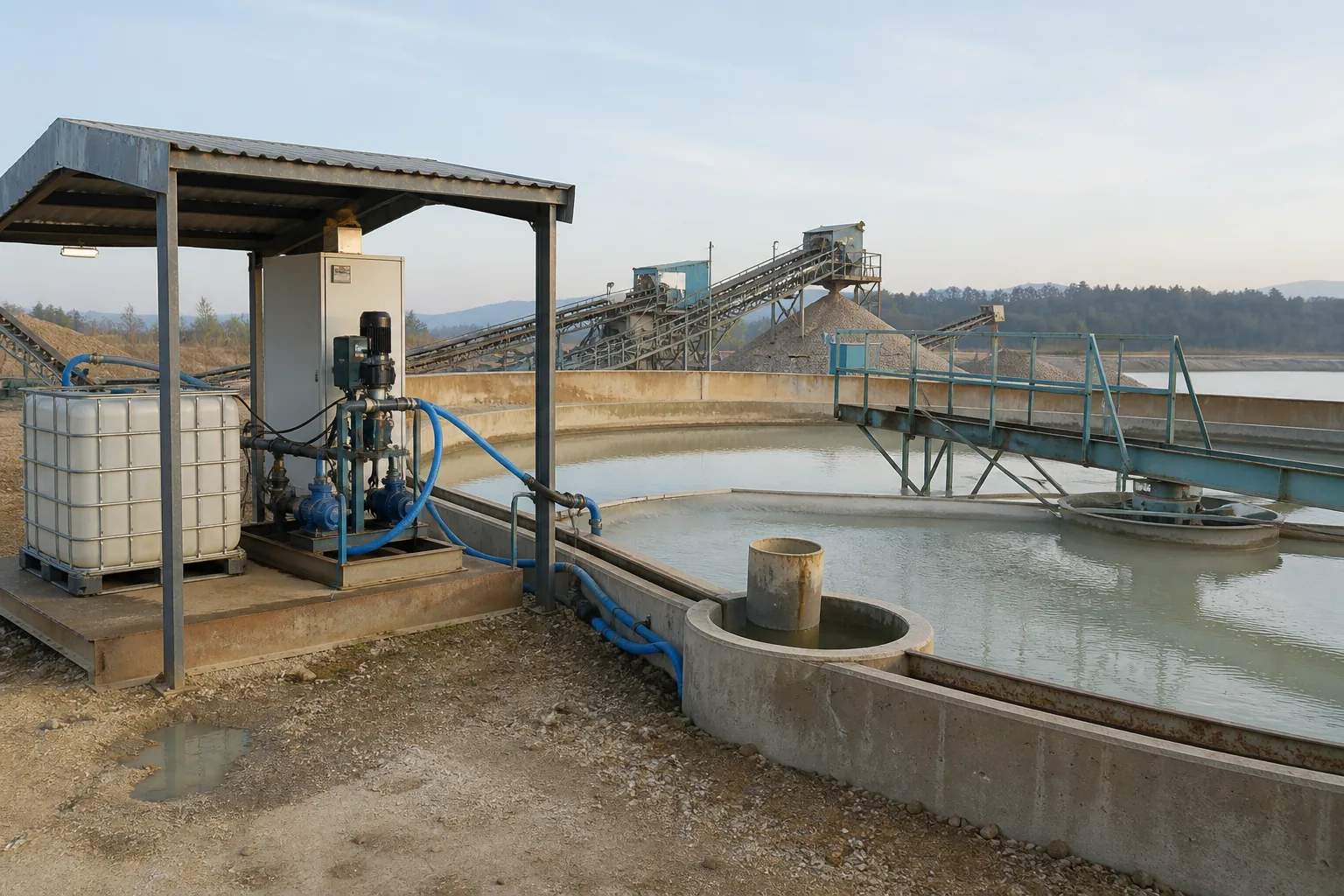
Use the actual process water
Clay fraction, grinding chemistry, hardness, salinity and accumulated recycle species can change emulsion inversion and polymer adsorption. Test the operating slurry and water rather than rebuilding the feed in clean laboratory water.
Record solids loading, particle-size context, pH, conductivity, upstream reagents and normal variability.
Protect the full separation balance
Measure initial settling, interface movement, overflow clarity, compacted volume and floc response after shear. For a thickener, include feedwell dilution and bed behavior; for aggregate washing, include recycle clarity and sludge withdrawal.
Reject a dose that creates fast settling but unstable overflow or an unmanageable bed.
Plan liquid-product logistics
Remote or cold sites must review IBC handling, temperature exposure, turnover, secondary containment and water availability for inversion. Compare freight and storage on an active-polymer basis.
The sample request should name the separator, process water, intended inversion system, quantity, destination and decision endpoints.