
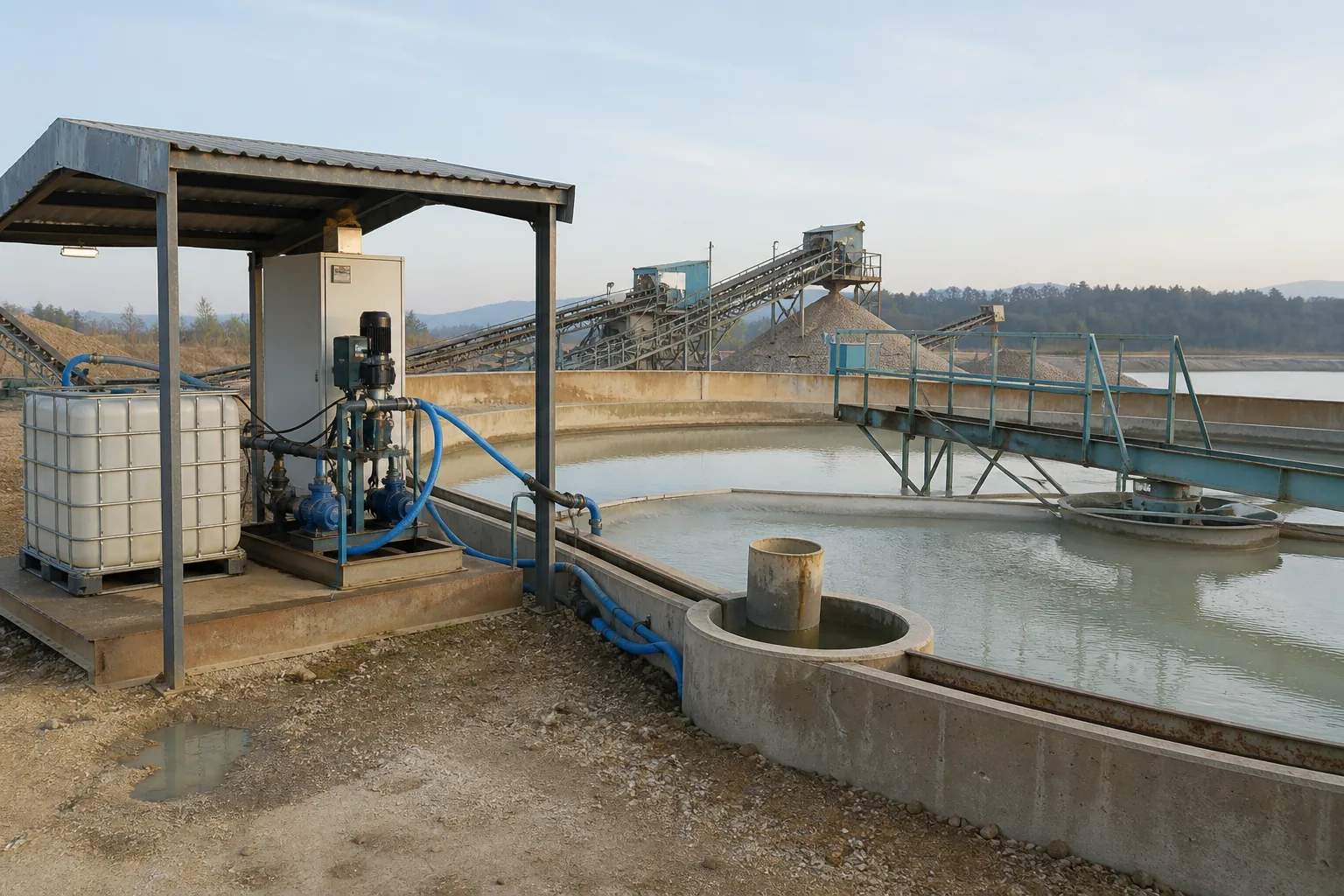
Map the particle and water condition
Anionic emulsion grades are often screened for mineral suspensions or after metal-salt coagulation. Surface sites, hardness, salinity, pH and upstream coagulant residual can change adsorption and bridging even when the dry-solids concentration appears unchanged.
Send mineral or solids source, particle-size context, recycle-water fraction, conductivity and current chemistry with the sample request. The anionic label does not define one universal application window.
Hold inversion and contact energy steady
Prepare every candidate through the same inversion system and compare on an active-polymer basis. Apply repeatable rapid dispersion followed by controlled low-shear floc growth. Measure interface movement and clear-water quality at defined times.
Large visible floc is not enough. Retain overflow turbidity or suspended solids, compacted volume, fines capture and recovery after a controlled shear step.
Transfer the dose to actual flow
Locate the injection point relative to pumps, elbows, feedwells and the separator. Scale the selected active dose on dry solids or another stable loading basis, then bracket the dose during a plant trial.
Include expected neat-product consumption, IBC or drum preference, destination, storage limits and required documents when moving from sample to supply.