
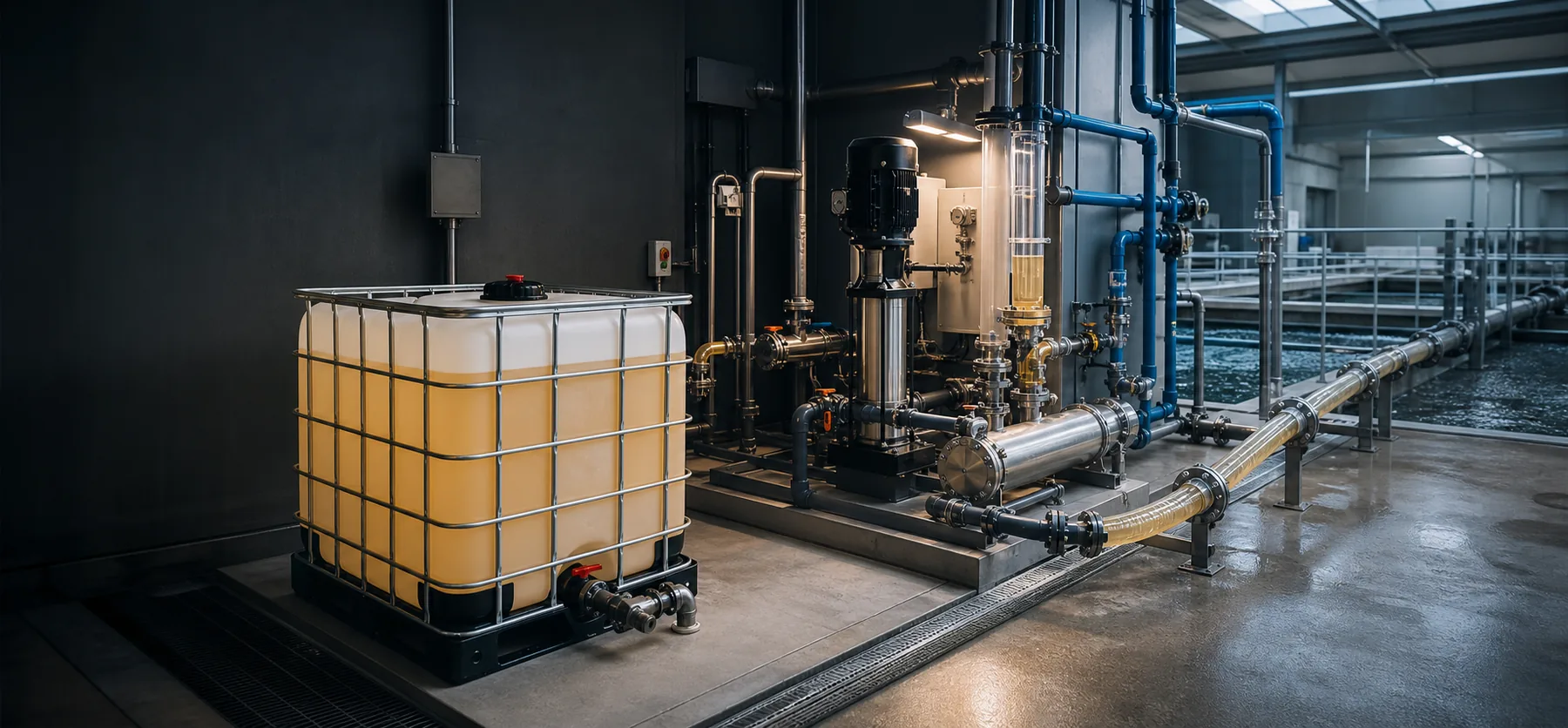
Confirm the design basis
List product form, expected viscosity range, package, neat and active demand, water source, turndown, target solution range, injection pressure and operating schedule. Verify that wetted materials and containment match the actual product guidance.
A skid sized only for average consumption can fail at startup, peak load or low turndown.
Trace the complete flow path
Walk from receiving connection through storage, transfer, day supply, neat metering, water contact, activation, maturation, dilution and injection. Confirm valve position, drainage, flushing and sample points.
Labeling and physical line identification must prevent water from entering neat storage and prevent product from reaching the wrong process point.
Wet-test with safe media
Follow the equipment plan to test water paths, leaks, alarms, low-flow conditions and shutdown behavior before introducing product. Verify that failure of water flow stops neat emulsion delivery.
Confirm containment and drainage without sending test liquid to an unsuitable destination.
Calibrate across the operating range
Measure water and product delivery at low, normal and high setpoints against independent volume or mass. Record discharge pressure and repeatability. Configure alarms around actual stable ranges rather than nominal catalog values.
Recheck calibration after initial product exposure because viscosity and backpressure may change pump behavior.
Qualify the activated solution
Introduce product under supplier-recommended conditions and inspect uniformity, pressure, residence and transfer. Compare a controlled sample with the expected application response.
Avoid using appearance or viscosity as the only acceptance test; connect activation to measurable separation.
Run process acceptance
Establish a baseline, bracket active dose and allow for hydraulic or machine delay. Measure outlet quality, rate, capture, cake or other equipment endpoints while holding unrelated settings stable.
Define stop conditions for unsafe pressure, poor outlet quality or mechanical instability.
Handover the operating record
Provide verified calibration, normal ranges, alarms, startup, shutdown, flushing, changeover, storage checks, sampling and troubleshooting. Record product code and qualified lot.
Schedule early inspection of injection points and filters so deposits are found before performance drifts.
Test control and failure states
Simulate loss of dilution water, low tote level, pump trip and high discharge pressure according to the approved plan. Confirm neat emulsion stops before the water-contact zone becomes an uncontrolled deposit point and alarms identify the failed condition.
Document recovery steps and require deliberate restart. Automatic restart after a prolonged fault can send unactivated or overly concentrated material downstream.
Define early-life monitoring
During the first operating weeks, review calibrated consumption, pressure, injector cleanliness, solution appearance and treatment endpoint more frequently than routine operation. Compare actual turndown and peak demand with the design basis.
Close commissioning only when operators can reproduce startup, normal control, shutdown and fault recovery, with remaining limitations recorded.